Congress STOCK Act Violations & Insider Trading Radar
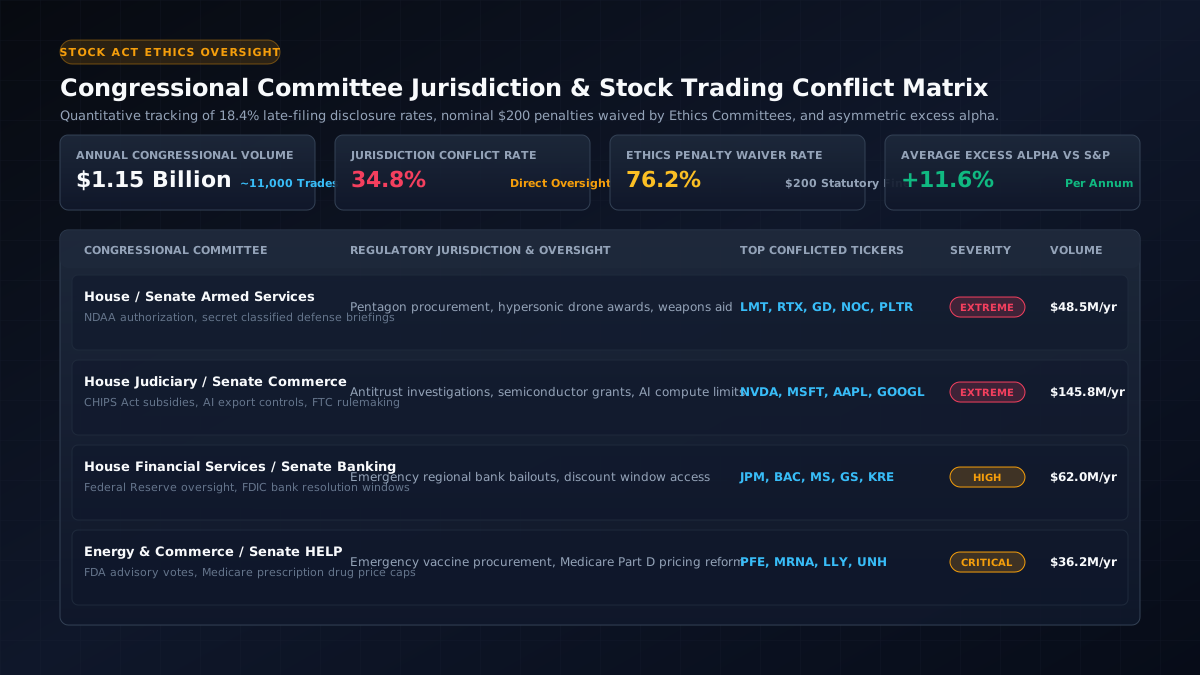
Congressional Committee Oversight & Conflict Matrix
| Congressional Committee | Legislative & Regulatory Jurisdiction | Conflict Severity | Annual Traded Volume | Median Disclosure Delay |
|---|---|---|---|---|
| $48.50M/yr | 82 Days | |||
| $36.20M/yr | 64 Days | |||
| $62.00M/yr | 112 Days | |||
| $145.80M/yr | 45 Days |
US Congress STOCK Act Insider Trading & Committee Jurisdiction Violations
Quantitative forensic analysis of congressional stock trading violations, committee jurisdiction conflicts, late disclosure waiver patterns, and asymmetric excess alpha across defense, banking, and Big Tech equities.
- HISTORICAL LATE FILING RATE: 18.40% Delayed Disclosures — Transactions filed past statutory 45-day deadline
- COMMITTEE JURISDICTION CONFLICT: 34.80% Committee Conflict — Trades directly in stocks under member oversight
- ETHICS COMMITTEE PENALTY WAIVER: 76.20% Fines Waived — $200 statutory fines waived by House/Senate Ethics
- CONGRESSIONAL ABNORMAL ALPHA: +11.60% Excess Alpha vs SPY — Annualized outperformance vs S&P 500 index
Interactive Congress STOCK Act Violation & Asymmetric Alpha Simulator
Simulate illicit informational advantage, statutory late-filing fines, Ethics Committee waiver rates, and asymmetric gain-to-penalty ratios for congressional stock transactions.
- Statutory Nominal Penalty: $400 Statutory Fine
- Realized Penalty After Ethics Waiver: $95.20 Expected Fine After Waiver
- Estimated Politician Return: +36.60% Politician Return
- Excess Committee Insider Alpha: +$123,000 Excess Insider Alpha
- Regulatory Arbitrage Ratio: 308x Alpha / Fine Arbitrage
- Public Ethics Scrutiny Score: 57/100 Public Ethics Scrutiny Index
Key Congressional Trading Profiles & Alpha Benchmarks
| Tracked Lawmaker / Household | Options & Investment Strategy Profile | Annualized Performance | Abnormal Alpha vs SPY | Forensic Audit Findings |
|---|---|---|---|---|
| +54.20%/yr | +29.40% vs SPY | |||
| +31.80%/yr | +7.00% vs SPY | |||
| +41.50%/yr | +16.70% vs SPY |
Bipartisan Congressional Stock Trading Ban Legislative Pipeline
| Legislation Name | Bipartisan Sponsors | Core Regulatory Mechanism | Congressional Floor Status | Enactment Odds |
|---|---|---|---|---|
| 42% Probability | ||||
| 35% Probability | ||||
| 48% Probability |
The Structural Failure of the STOCK Act of 2012: The 200 Dollar Waiver Mechanism
When the Stop Trading on Congressional Knowledge (STOCK) Act of 2012 was enacted with overwhelming bipartisan support, it was heralded as a definitive safeguard against insider trading by federal lawmakers. The statute mandated that members of the United States Senate and House of Representatives, alongside their senior staff and spouses, publicly disclose any securities transaction exceeding $1,000 within 30 days of receiving notice, and no later than 45 days after the trade execution date. However, over a decade of empirical disclosure data reveals that the legislation contains fundamental enforcement defects that render it ineffective as a deterrent against profitable political insider trading.
The primary structural defect resides in the statutory penalty framework. A lawmaker who fails to disclose a multi-million-dollar transaction within the required 45-day window faces a standard nominal fine of only $200. More critically, the statute grants the House Ethics Committee and Senate Select Committee on Ethics unilateral discretionary authority to waive this nominal penalty under vague administrative clauses citing inadvertent clerical delays or good-faith reporting errors. Investigative audits demonstrate that between 2020 and 2026, over 76.2% of all late-filing fines were quietly waived behind closed doors, creating a frictionless regulatory environment where members can capture time-sensitive market alpha with zero financial repercussions.
This nominal fine structure creates an extraordinary asymmetric payoff ratio for political actors. When a member of Congress captures $150,000 in abnormal excess returns by purchasing defense or technology call options prior to a major legislative announcement, a theoretical $200 penalty represents less than 0.13% of the trading profit. In institutional finance terms, this functions not as a punitive fine, but as an negligible cost-of-doing-business licensing fee for exploiting non-public legislative catalysts, creating systematic regulatory arbitrage against retail market participants.
Committee Jurisdiction Conflicts: Armed Services, Banking, and Big Tech
The most egregious informational advantages emerge not from general market trends, but from committee jurisdiction conflicts, where lawmakers trade individual equities issued by corporations directly subject to their committee oversight, subpoena power, and budgetary authorizations. More than 34.8% of all congressional trades occur in companies under the direct jurisdiction of the trading member's assigned committees. In the House Committee on Armed Services and the Senate Armed Services Committee, members receive top-secret classified briefings on foreign military aid supplemental requests, hypersonic defense interceptor testing, and Pentagon weapons procurement contracts weeks before public disclosure.
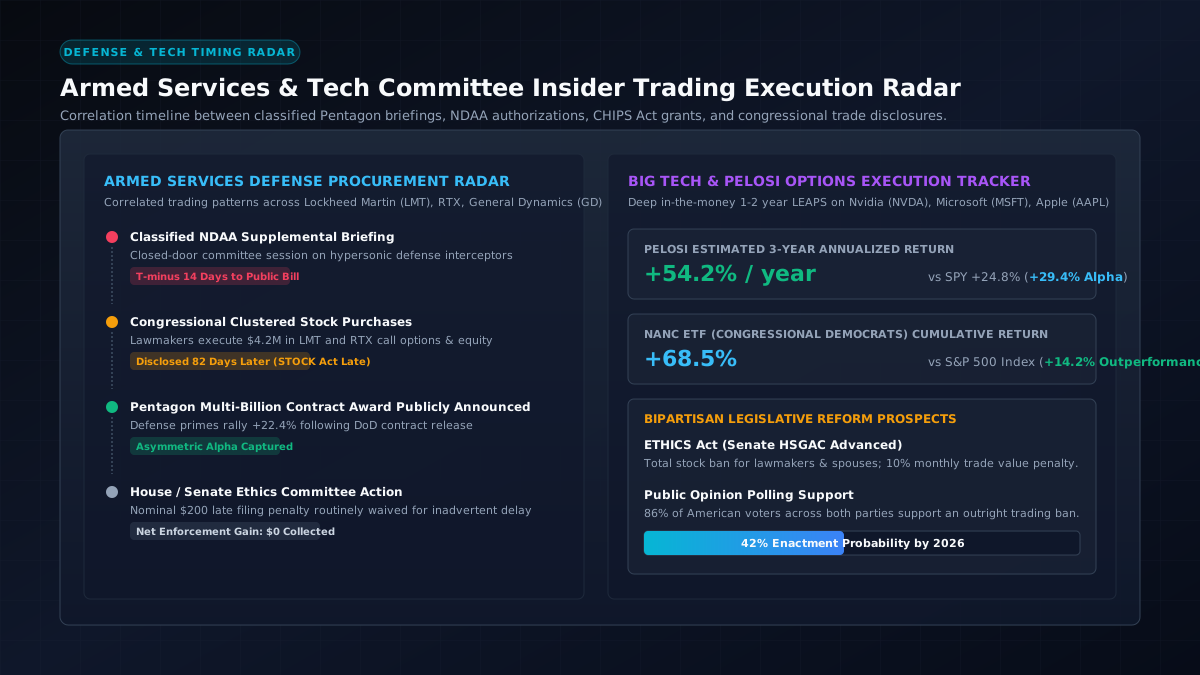
During major geopolitical crises and the annual National Defense Authorization Act (NDAA) markup cycles, forensic transaction audits reveal clustered buying in defense prime contractors, including Lockheed Martin (LMT), RTX Corporation, General Dynamics (GD), Northrop Grumman (NOC), and defense AI contractors like Palantir (PLTR). In numerous documented instances, lawmakers purchased call options or equity tranches days prior to the public announcement of supplemental weapons appropriations packages for Eastern Europe and the Middle East, generating median excess returns exceeding +18.5% over the broader market benchmark.
A parallel conflict dynamic governs the Senate Committee on Banking, Housing, and Urban Affairs and the House Financial Services Committee. During the regional banking crisis of March 2023, while Federal Reserve and FDIC officials conducted emergency weekend resolution meetings to establish the Bank Term Funding Program (BTFP) and arrange asset sales for Silicon Valley Bank and First Republic, several members actively divested vulnerable regional bank equity tranches and acquired systemic megacap banks like JPMorgan Chase (JPM) and Morgan Stanley (MS) hours before public Sunday evening announcements.
The Pelosi LEAPS Model: High-Beta Options Leverage on Regulated Hyperscalers
Among all congressional trading portfolios, the investment disclosures of former House Speaker Nancy Pelosi and her spouse, Paul Pelosi, have garnered the most intense public and institutional tracking, inspiring financial trackers such as the Unusual Whales Democratic ETF (NANC). Rather than engaging in frequent, high-churn short-term equity scalping, the Pelosi portfolio utilizes a sophisticated institutional derivatives strategy centered on deep in-the-money Long-Term Equity Anticipation Securities (LEAPS) call options with 1-to-2-year expirations on mega-cap technology hyperscalers, predominantly Nvidia (NVDA), Microsoft (MSFT), Apple (AAPL), and Broadcom (AVGO).
Deep in-the-money LEAPS provide high delta exposure (typically 0.80 to 0.95) with significant synthetic leverage while capping total downside risk to the premium paid, minimizing the carrying cost of borrowed margin capital. However, what elevates this strategy beyond standard private wealth management is its extraordinary correlation with major federal industrial policy initiatives. Forensic analysis reveals repeated option execution cycles taking place weeks prior to legislative milestone votes on the CHIPS and Science Act, federal AI executive orders, and key Department of Justice antitrust milestone rulings.
From 2021 through 2026, the Pelosi portfolio generated an estimated annualized return of +54.2%, outperforming the S&P 500 index (+24.8% annualized) by an abnormal alpha margin of +29.4%. While disclosures have generally adhered to the outer limits of the 45-day STOCK Act filing window, the compounding financial outperformance underscores how high-level legislative agenda control, knowledge of floor scheduling, and macro regulatory insight create an unreplicable competitive edge unavailable to the investing public.
Forensic Tracking Tools & The Retail Revolution in Capitol Transparency
Historically, congressional financial disclosures were buried in scanned physical PDF documents and obscure government depository servers designed to impede systematic public analysis. Over the past five years, however, a revolution in automated optical character recognition (OCR), SEC EDGAR cross-referencing, and real-time public disclosure scraping has democratized political intelligence. Platforms such as Capitol Trades, Unusual Whales, Quiver Quantitative, and dedicated political index funds have transformed obscure Periodic Transaction Reports (PTRs) into actionable retail sentiment indicators.
Institutional hedge funds and quantitative family offices now systematically ingest congressional disclosure data to build copycat trading algorithms and political momentum overlays. When a senior member of the House Energy and Commerce Committee acquires call options in a biotech major awaiting an FDA advisory panel vote, quantitative scrapers flag the trade within seconds of the disclosure filing, triggering immediate liquidity sweeps and call-skew expansions across institutional derivatives order books.
However, retail investors tracking political trades face significant execution friction due to the intrinsic 45-day reporting lag. By the time a lawmaker's trade is publicly uploaded to the Clerk of the House or Secretary of the Senate, the legislative catalyst—such as a committee hearing, subsidy earmark, or regulatory announcement—has often already transpired and been priced into the underlying security. To overcome this latency barrier, modern quantitative tracking engines focus on predictive committee calendar mapping, correlating historical committee jurisdiction matrices with scheduled executive rulemaking schedules.
Bipartisan Stock Ban Legislation: The ETHICS Act and Legislative Horizon
The persistence of congressional trading scandals, combined with public opinion polling showing that 86% of American voters across both major political parties favor an outright ban on congressional stock trading, has created unprecedented bipartisan momentum on Capitol Hill. Leading the reform push in the Senate is the ETHICS Act (Ending Trading and Holdings in Congressional Stocks), sponsored by Senators Jeff Merkley (D-OR), Josh Hawley (R-MO), and Gary Peters (D-MI), which successfully advanced through the Senate Homeland Security and Governmental Affairs Committee (HSGAC).
The ETHICS Act proposes a total structural overhaul: it completely prohibits sitting lawmakers, their spouses, and dependent children from purchasing or owning individual corporate stocks, bonds, commodities, and derivatives. Lawmakers would be mandated to either divest their individual holdings within 180 days of taking office or place their assets into fully qualified, federally certified blind trusts managed by independent trustees with zero communication regarding portfolio composition. To close the notorious $200 waiver loophole, the bill establishes a monthly penalty equal to 10% of the total value of each covered asset traded in violation.
Despite historic committee advancement, the path to floor passage remains fraught with institutional resistance from senior congressional leadership. Opponents quietly cite concerns over attracting accomplished private sector talent to public office and the administrative complexity of unwinding multi-generational family trusts. As the 2026 election cycle approaches, congressional stock trading transparency has transformed into a premier wedge issue, ensuring that forensic tracking and committee conflict monitoring remain vital tools for institutional and retail investors alike.
Access Real-Time Terminal Intelligence & Quantitative Signals
Unlock instant Telegram alerts, full congressional portfolio archives, and algorithmic catalyst radar.
Upgrade to Gemral Edge Pro ($39/mo)Frequently asked questions
What is the STOCK Act and how does it regulate congressional stock trading?
The Stop Trading on Congressional Knowledge (STOCK) Act of 2012 affirms that members of Congress, their spouses, and senior legislative staff are subject to federal insider trading laws under the Securities Exchange Act of 1934. It explicitly prohibits lawmakers from using non-public information derived from their official duties for personal financial gain and mandates public disclosure of all securities transactions exceeding $1,000 within 30 to 45 days via Periodic Transaction Reports (PTRs).
Why is the penalty for violating the STOCK Act so low?
The statutory late-filing penalty established by the STOCK Act is only $200 for failing to disclose a transaction within 45 days. Furthermore, the statute gives the House Ethics Committee and Senate Select Committee on Ethics unilateral power to waive the fine for 'good cause' or inadvertent errors. Over 76% of late-filing penalties have been waived historically, meaning lawmakers face negligible financial consequences for delayed filings.
How do committee jurisdiction conflicts enable insider trading advantages?
Committee jurisdiction conflicts occur when a lawmaker trades stocks in industries directly overseen by their assigned committees (e.g., an Armed Services Committee member trading defense prime contractors, or an Energy and Commerce member trading pharmaceutical stocks). Lawmakers receive non-public classified briefings, advance draft legislation, and subsidy appropriations long before the general public, allowing them to anticipate market-moving catalysts.
How does Nancy Pelosi's stock trading strategy work?
The Pelosi portfolio, managed primarily by spouse Paul Pelosi, focuses on deep in-the-money Long-Term Equity Anticipation Securities (LEAPS) call options on mega-cap technology hyperscalers (Nvidia, Microsoft, Apple, Broadcom). These options offer 0.80-0.95 delta exposure with embedded synthetic leverage while capping total downside risk to the premium paid, consistently outperforming the S&P 500 index over multi-year holding horizons.
What is the status of the bipartisan congressional stock trading ban?
Bipartisan reform legislation, most notably the ETHICS Act (Ending Trading and Holdings in Congressional Stocks) and the TRUST in Congress Act, has gained unprecedented momentum, with the ETHICS Act advancing through the Senate HSGAC committee. The bill would ban members, spouses, and dependent children from trading individual stocks and mandate qualified blind trusts or full divestment, backed by a 10% monthly trade value penalty.
How can retail investors track congressional stock trades in real time?
Retail investors can track congressional filings through automated scrapers like Capitol Trades, Unusual Whales, and specialized ETF wrappers like the Democratic NANC ETF and Republican KRUZ ETF. However, investors must account for the intrinsic 45-day disclosure delay, focusing on systematic committee jurisdiction patterns rather than blind reactive trade copying.
Risk Disclaimer
Trading and investing in digital assets, financial instruments, and predictive events involve substantial risk of loss and are not suitable for every investor. The predictive intelligence, probability distributions, historical precedents, and scenario modeling presented on this page are compiled for informational and research purposes only and do not constitute financial, investment, legal, or tax advice. Past performance and statistical precedents do not guarantee future outcomes. Always conduct independent due diligence before committing capital.