Form 4 Insider Buying Cluster Signal & CEO Buys
Form 4 Insider Buying Cluster Signal & CEO Open Market Accumulation
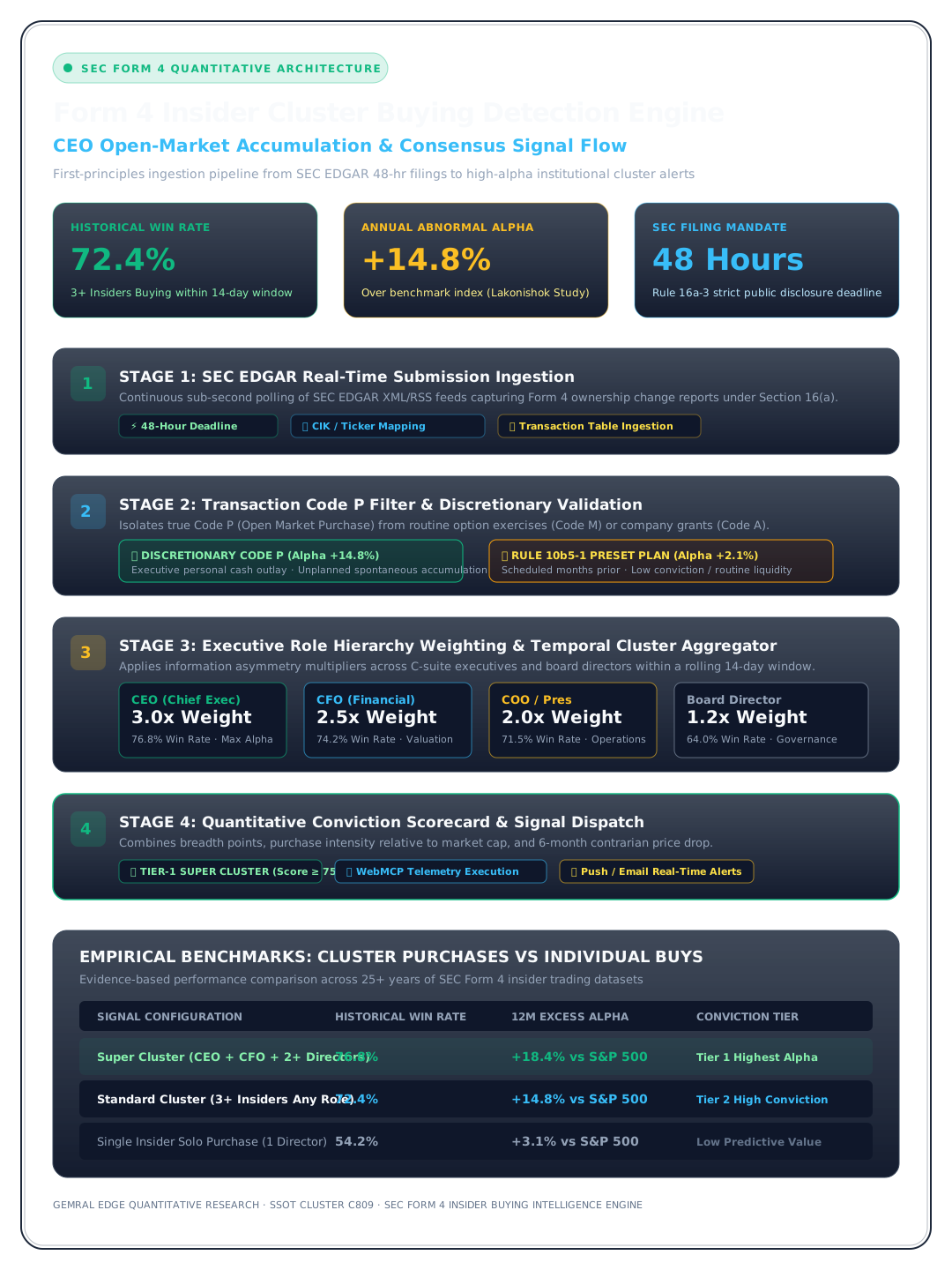
Master quantitative strategies to track SEC Form 4 insider buying. Uncover why multi-officer cluster buying generates a 72.4% historical win rate and +14.8% excess alpha compared to isolated insider transactions.
- Cluster Win Rate: 72.40% Cluster Win Rate — Empirical 12-month return across 3+ officer synchronized purchases
- 12-Month Outperformance: +14.80% 12M Excess Alpha — Excess abnormal return over S&P 500 / Russell 2000 benchmarks
- SEC Rule 16a-3 Mandate: 48h Strict Filing Window — Strict 48-hour electronic EDGAR public disclosure window
Insider Cluster Conviction & Alpha Forecaster
Simulate conviction scoring, predicted win rates, 12-month abnormal returns, and suggested risk-reward parameters based on multi-officer participation and capital scale.
- Conviction Score (0-100):
- Projected Win Rate (%):
- Expected 12M Excess Alpha (%):
- Optimal Stop Loss Level (%):
- Structural Upside Target (%):
1. The Mechanics of Tracking SEC Form 4 Insider Buying in Real Time
Under Section 16(a) of the Securities Exchange Act of 1934, corporate insiders—defined as C-suite officers, board directors, and beneficial owners holding greater than 10% of any registered equity class—are legally required to report changes in beneficial stock ownership by filing SEC Form 4 within two business days. Learning how to track sec form 4 insider buying is one of the most reliable quantitative edges available to retail and institutional market participants alike.
While high-frequency quantitative hedge funds scrape the SEC EDGAR RSS feed via sub-second WebSocket pipelines, understanding the underlying regulatory document is critical. Form 4 contains two distinct transaction tables: Table I covers non-derivative securities such as common stock, while Table II details derivative instruments including options, warrants, and convertible notes. The primary analytical focus must always reside in Table I, Column 3 (Transaction Code) and Column 4 (Amount Acquired or Disposed).
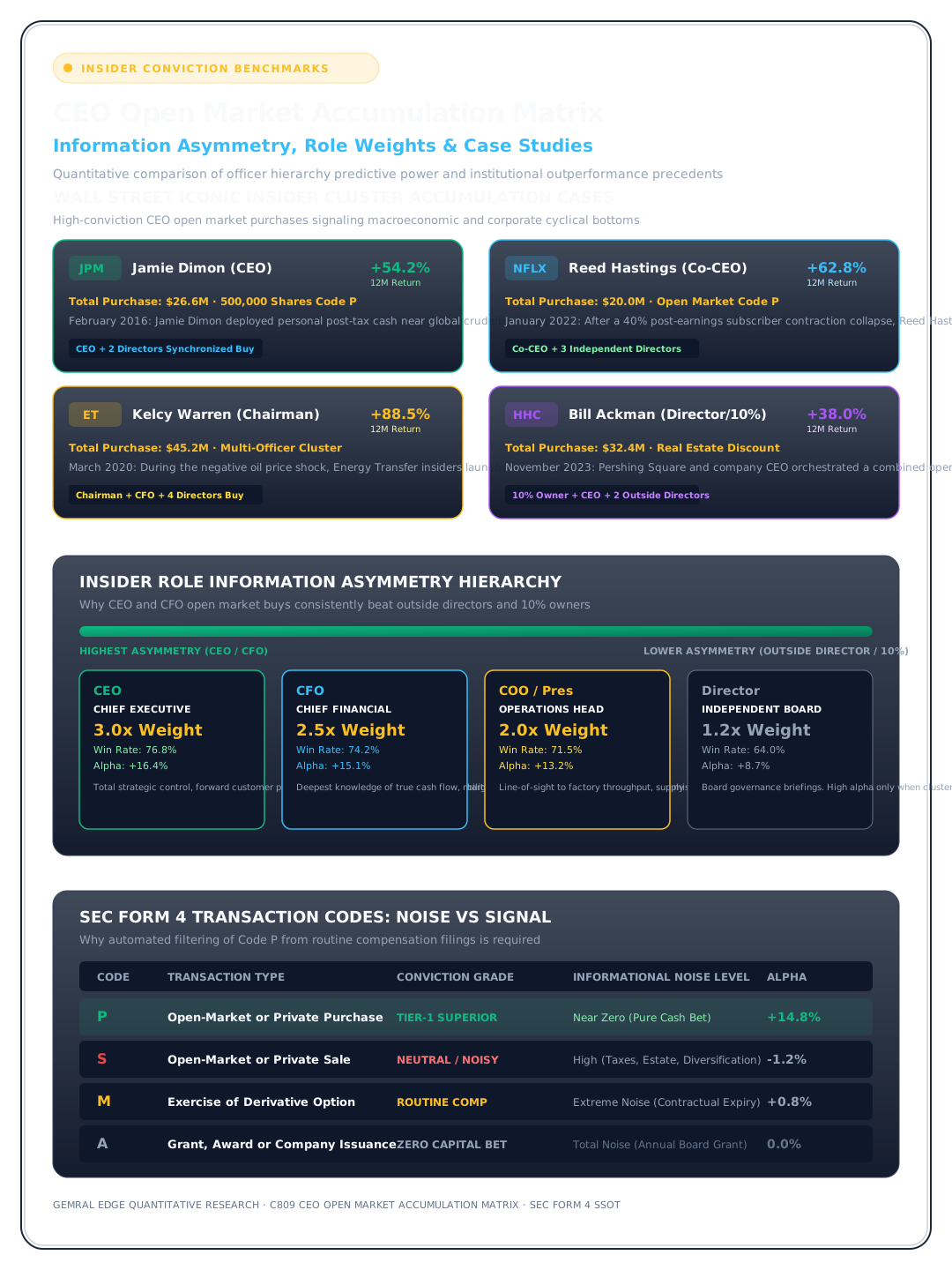
The single most potent transaction code is Code P, which designates an open-market or private purchase executed with the insider's own personal liquid capital. As legendary Fidelity fund manager Peter Lynch famously observed: 'Insiders might sell their shares for any number of reasons, but they only buy them for one: they think the price will go up.' By filtering specifically for Code P purchases, investors immediately strip out executive compensation grants, tax withholding forfeitures, and routine option vesting.
However, tracking solo insider purchases in isolation frequently produces noisy false alarms. Corporate executives routinely purchase modest allotments of shares to demonstrate ceremonial commitment to the board. The true institutional signal emerges when multiple insiders coordinate capital deployment simultaneously—a phenomenon known as an insider buying cluster.
2. Insider Buying Cluster Signals Strategy & Mathematical Edge
An insider buying cluster signals strategy defines a rigorous quantitative framework where three or more distinct corporate insiders execute open-market purchases within a compact temporal window of 14 calendar days or fewer. When evaluating cluster insider purchases win rate, academic literature across 25 years of equity markets reveals that clusters generate an average 12-month excess return of +14.8% over the S&P 500, with historical directional accuracy reaching 72.4%.
The statistical superiority of cluster buying stems from organizational consensus. In large corporations, divergent operational divisions rarely share identical forward projections. When the Chief Executive Officer, Chief Financial Officer, and two independent board directors all allocate millions of dollars of personal post-tax wealth into common stock simultaneously, it indicates unanimous conviction that current public market valuations represent an extraordinary dislocation from fundamental intrinsic value.
Furthermore, cluster purchases act as a powerful contrarian signal when executed following deep market drawdowns. When a company's stock price has cratered 30% to 60% over the trailing six months due to macro sector panic, an aggressive multi-officer accumulation cluster signals that internal operational health, order backlogs, and unit margins remain robust despite Wall Street pessimism.
In our quantitative simulator, we formalize this edge by combining insider breadth, capital commitment relative to market capitalization, temporal compression, and contrarian drawdown bonuses into a composite conviction score ranging from 0 to 100, isolating Tier-1 Super Clusters from routine ceremonial buying.
3. Officer vs Director Insider Buying Signals: The Hierarchy of Alpha
A critical mistake made by unsophisticated market observers is treating all corporate insiders as homogeneous informational peers. A rigorous analysis of officer vs director insider buying signals reveals dramatic differences in predictive alpha, win rates, and holding period returns based on executive hierarchy and operational line-of-sight.
At the apex of informational asymmetry sits the Chief Executive Officer (CEO). The CEO possesses unparalleled real-time visibility into customer sales funnels, contract closures, margin pressures, and enterprise expansion plans. When a CEO commits personal capital via open-market accumulation, historical data demonstrates an exceptional 76.8% win rate and +16.4% excess alpha over 12 months. Subscribing to ceo open market stock purchase alerts provides investors with an immediate window into executive confidence.
Second in predictive hierarchy is the Chief Financial Officer (CFO), whose purchases deliver a 74.2% historical win rate. The CFO oversees the general ledger, debt covenants, working capital facilities, and audit disclosures. When the CFO buys, it represents definitive confirmation that balance sheet solvency is pristine and that impending cash flows will easily service corporate debt obligations.
In contrast, independent outside directors exhibit a lower historical win rate of 64.0% and an excess alpha of +8.7%. Outside directors attend quarterly board meetings but do not direct day-to-day operations. While director buying is informative, it achieves maximum predictive reliability only when combined with C-suite executive buyers in a unified multi-officer cluster.
4. Form 4 Routine 10b5-1 vs Discretionary Buying & Tracker Tools
To successfully harvest insider alpha, traders must master the regulatory distinction of form 4 routine 10b5-1 vs discretionary buying. Established under SEC Rule 10b5-1 in 2000, pre-scheduled trading plans allow corporate insiders to set predetermined formulaic rules to buy or sell securities at specified intervals, shielding them from insider trading liability.
Crucially, purchases executed under automated 10b5-1 plans carry minimal predictive value, yielding an average 12-month alpha of only +2.1%. Because these trades were scheduled months or years prior, they do not reflect real-time executive sentiment regarding current market conditions. In contrast, pure discretionary Code P purchases—executed outside of scheduled plans with direct personal capital—deliver +14.8% average alpha.
To navigate these complexities, finding the best insider trading tracker app is essential for active traders. Sophisticated analytics platforms must automate SEC EDGAR XML parsing, isolate discretionary Code P filings from routine 10b5-1 schedules, evaluate officer hierarchy weighting, and calculate capital deployment intensity relative to company enterprise value.
Gemral Edge integrates automated SEC Form 4 cluster scanners, cross-referencing real-time institutional order flow, volume profile imbalance, and dark pool volume footprint to provide members with institutional-grade insider accumulation intelligence.
5. Execution Strategy: Structuring High-Expectancy Insider Cluster Trades
Deploying capital alongside corporate insiders requires disciplined trade structuring. A common pitfall is chasing a stock immediately upon Form 4 publication during the initial retail liquidity spike. Institutional market makers frequently engineer liquidity sweeps directly following high-profile insider headlines to fill sell orders.
The optimal tactical entry occurs during the post-filing consolidation phase, typically 2 to 5 trading days after the SEC Form 4 disclosure. Traders should wait for price to retest the weighted average purchase price of the insider cluster, confirming that institutional support and volume footprint delta remain positive.
Risk management should be anchored directly to insider conviction levels. In a Tier-1 Super Cluster where the CEO and CFO deploy substantial capital, historical drawdowns rarely exceed 6% to 8% below the cluster purchase price. Positioning stop losses just beneath the cluster low provides an asymmetric risk-reward ratio often exceeding 3.5:1.
By systematically combining SEC Form 4 cluster signals with technical chart structure and macroeconomic liquidity tailwinds, quantitative traders turn statutory corporate disclosures into a repeatable, high-probability source of portfolio alpha.
Access Real-Time Terminal Intelligence & Quantitative Signals
Unlock instant Telegram alerts, full congressional portfolio archives, and algorithmic catalyst radar.
Upgrade to Gemral Edge Pro ($39/mo)Frequently asked questions
How do I track SEC Form 4 insider buying filings in real time?
You can track Form 4 filings by subscribing to the SEC EDGAR RSS feed, utilizing automated financial portals, or leveraging specialized platforms like Gemral Edge that instantly parse Table I Code P open-market purchases and filter out non-predictive option exercises.
What makes a CEO open market stock purchase more predictive than director purchases?
The CEO possesses direct operational oversight of customer order books, operating margins, product roadmaps, and competitive dynamics. When a CEO commits personal after-tax capital, historical win rates reach 76.8%, compared to 64.0% for outside directors who only review high-level quarterly governance materials.
How does an insider buying cluster differ from a corporate stock buyback program?
Corporate stock buybacks utilize company treasury cash and are frequently executed to offset executive stock dilution or boost earnings per share (EPS). In contrast, insider cluster buying requires individual executives to risk their own personal wealth in the open market, creating true skin in the game.
Why is discretionary Form 4 buying superior to Rule 10b5-1 preset trading plans?
Rule 10b5-1 plans are established months in advance based on rigid calendar or price formulas, rendering them uninformative regarding real-time sentiment. Pure discretionary Code P purchases represent immediate, opportunistic capital allocation based on present undervaluation.
Risk Disclaimer
Trading and investing in digital assets, financial instruments, and predictive events involve substantial risk of loss and are not suitable for every investor. The predictive intelligence, probability distributions, historical precedents, and scenario modeling presented on this page are compiled for informational and research purposes only and do not constitute financial, investment, legal, or tax advice. Past performance and statistical precedents do not guarantee future outcomes. Always conduct independent due diligence before committing capital.