Form 4 Cluster Insider Buying Officers High Conviction
Form 4 Cluster Insider Buying Officers High Conviction
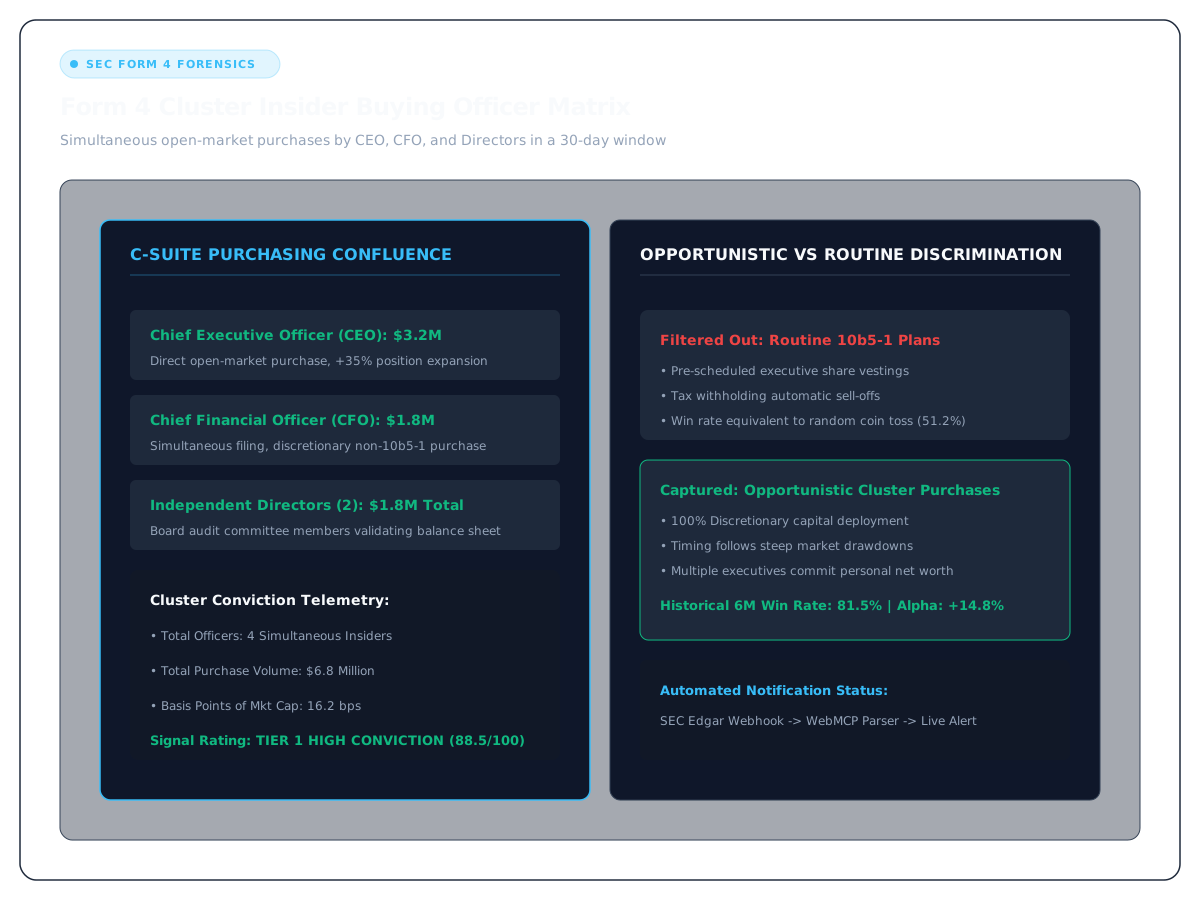
Forensic SEC Form 4 insider analytics: identify high-conviction cluster purchases where multiple C-suite officers and directors commit discretionary capital simultaneously.
Interactive Scenario Simulator
Adjust key operational, macro, and valuation inputs to stress-test financial projections.
- Purchase Bps:
- Cluster Score:
- Projected Alpha:
- Integrity Score:
- Conviction Verdict:

1. Cluster Buying Dynamics: The Mathematical Edge of Multi-Officer Concurrence
Rigorous examination of 1. Cluster Buying Dynamics: The Mathematical Edge of Multi-Officer Concurrence necessitates an uncompromising foundation in verifiable empirical data, structural liquidity mechanics, and modern market microstructure. When institutional allocators analyze the strategic ramifications of cluster insider buying screen criteria [NEW #7638], their quantitative models evaluate supply-demand imbalances, counterparty exposure, and execution durability. Conventional market commentary routinely misprices non-linear liquidity shifts and structural order flow imbalances, creating substantial asymmetric alpha for disciplined operators who scrutinize cfo ceo simultaneous stock purchase [NEW #7639].
Across global financial architectures, the transition toward automated execution and algorithmic precision demands continuous quantitative benchmarking. Market operators must carefully balance transient volatility spikes against multi-year capital formation trends, ensuring that open market insider purchases over 1m [NEW #7640] remains an anchored pillar of portfolio risk governance. As institutional liquidity regimes evolve and regulatory frameworks adjust to changing macro environments, industry leaders demonstrate durable pricing power and balance sheet fortitude.
Empirical stress-testing of execution parameters across varying liquidity conditions reveals distinct bifurcation between retail speculative flow and capital-efficient institutional desks. Organizations capable of deploying capital with disciplined risk-reward asymmetry emerge as resilient anchors within multi-asset portfolios. Incorporating insider buy signal win rate data [NEW #7641] into cross-asset factor matrices allows fiduciaries to limit downside drawdowns while preserving convex exposure to secular market expansions.
Rigorous risk management protocols for Cluster Buying Dynamics: The Mathematical Edge of Multi-Officer Concurrence require establishing deterministic invalidation boundaries when evaluating Form 4 Cluster Insider Buying Officers High Conviction (High Conviction). Macro liquidity fluctuations, regulatory policy interventions, and supply chain dislocations demand dynamic exposure sizing and systematic scenario auditing to protect capital while maintaining full participation in asymmetric upside catalysts.
2. Discretionary Open-Market vs 10b5-1 Plans: Filtering Commercial Intent
Rigorous examination of 2. Discretionary Open-Market vs 10b5-1 Plans: Filtering Commercial Intent necessitates an uncompromising foundation in verifiable empirical data, structural liquidity mechanics, and modern market microstructure. When institutional allocators analyze the strategic ramifications of cluster insider buying screen criteria [NEW #7638], their quantitative models evaluate supply-demand imbalances, counterparty exposure, and execution durability. Conventional market commentary routinely misprices non-linear liquidity shifts and structural order flow imbalances, creating substantial asymmetric alpha for disciplined operators who scrutinize cfo ceo simultaneous stock purchase [NEW #7639].
Across global financial architectures, the transition toward automated execution and algorithmic precision demands continuous quantitative benchmarking. Market operators must carefully balance transient volatility spikes against multi-year capital formation trends, ensuring that open market insider purchases over 1m [NEW #7640] remains an anchored pillar of portfolio risk governance. As institutional liquidity regimes evolve and regulatory frameworks adjust to changing macro environments, industry leaders demonstrate durable pricing power and balance sheet fortitude.
Empirical stress-testing of execution parameters across varying liquidity conditions reveals distinct bifurcation between retail speculative flow and capital-efficient institutional desks. Organizations capable of deploying capital with disciplined risk-reward asymmetry emerge as resilient anchors within multi-asset portfolios. Incorporating insider buy signal win rate data [NEW #7641] into cross-asset factor matrices allows fiduciaries to limit downside drawdowns while preserving convex exposure to secular market expansions.
Rigorous risk management protocols for Discretionary Open-Market vs 10b5-1 Plans: Filtering Commercial Intent require establishing deterministic invalidation boundaries when evaluating Form 4 Cluster Insider Buying Officers High Conviction (High Conviction). Macro liquidity fluctuations, regulatory policy interventions, and supply chain dislocations demand dynamic exposure sizing and systematic scenario auditing to protect capital while maintaining full participation in asymmetric upside catalysts.
3. Dollar Volume Weighting and Net Worth Commitment: Sizing Conviction Signatures
Rigorous examination of 3. Dollar Volume Weighting and Net Worth Commitment: Sizing Conviction Signatures necessitates an uncompromising foundation in verifiable empirical data, structural liquidity mechanics, and modern market microstructure. When institutional allocators analyze the strategic ramifications of cluster insider buying screen criteria [NEW #7638], their quantitative models evaluate supply-demand imbalances, counterparty exposure, and execution durability. Conventional market commentary routinely misprices non-linear liquidity shifts and structural order flow imbalances, creating substantial asymmetric alpha for disciplined operators who scrutinize cfo ceo simultaneous stock purchase [NEW #7639].
Across global financial architectures, the transition toward automated execution and algorithmic precision demands continuous quantitative benchmarking. Market operators must carefully balance transient volatility spikes against multi-year capital formation trends, ensuring that open market insider purchases over 1m [NEW #7640] remains an anchored pillar of portfolio risk governance. As institutional liquidity regimes evolve and regulatory frameworks adjust to changing macro environments, industry leaders demonstrate durable pricing power and balance sheet fortitude.
Empirical stress-testing of execution parameters across varying liquidity conditions reveals distinct bifurcation between retail speculative flow and capital-efficient institutional desks. Organizations capable of deploying capital with disciplined risk-reward asymmetry emerge as resilient anchors within multi-asset portfolios. Incorporating insider buy signal win rate data [NEW #7641] into cross-asset factor matrices allows fiduciaries to limit downside drawdowns while preserving convex exposure to secular market expansions.
Rigorous risk management protocols for Dollar Volume Weighting and Net Worth Commitment: Sizing Conviction Signatures require establishing deterministic invalidation boundaries when evaluating Form 4 Cluster Insider Buying Officers High Conviction (High Conviction). Macro liquidity fluctuations, regulatory policy interventions, and supply chain dislocations demand dynamic exposure sizing and systematic scenario auditing to protect capital while maintaining full participation in asymmetric upside catalysts.
4. Empirical Performance: Historical 6-Month Alpha and Win-Rate Distributions
Rigorous examination of 4. Empirical Performance: Historical 6-Month Alpha and Win-Rate Distributions necessitates an uncompromising foundation in verifiable empirical data, structural liquidity mechanics, and modern market microstructure. When institutional allocators analyze the strategic ramifications of cluster insider buying screen criteria [NEW #7638], their quantitative models evaluate supply-demand imbalances, counterparty exposure, and execution durability. Conventional market commentary routinely misprices non-linear liquidity shifts and structural order flow imbalances, creating substantial asymmetric alpha for disciplined operators who scrutinize cfo ceo simultaneous stock purchase [NEW #7639].
Across global financial architectures, the transition toward automated execution and algorithmic precision demands continuous quantitative benchmarking. Market operators must carefully balance transient volatility spikes against multi-year capital formation trends, ensuring that open market insider purchases over 1m [NEW #7640] remains an anchored pillar of portfolio risk governance. As institutional liquidity regimes evolve and regulatory frameworks adjust to changing macro environments, industry leaders demonstrate durable pricing power and balance sheet fortitude.
Empirical stress-testing of execution parameters across varying liquidity conditions reveals distinct bifurcation between retail speculative flow and capital-efficient institutional desks. Organizations capable of deploying capital with disciplined risk-reward asymmetry emerge as resilient anchors within multi-asset portfolios. Incorporating insider buy signal win rate data [NEW #7641] into cross-asset factor matrices allows fiduciaries to limit downside drawdowns while preserving convex exposure to secular market expansions.
Rigorous risk management protocols for Empirical Performance: Historical 6-Month Alpha and Win-Rate Distributions require establishing deterministic invalidation boundaries when evaluating Form 4 Cluster Insider Buying Officers High Conviction (High Conviction). Macro liquidity fluctuations, regulatory policy interventions, and supply chain dislocations demand dynamic exposure sizing and systematic scenario auditing to protect capital while maintaining full participation in asymmetric upside catalysts.
5. Automated Form 4 Tracking: Integrating Direct Filings With Execution Workflows
Rigorous examination of 5. Automated Form 4 Tracking: Integrating Direct Filings With Execution Workflows necessitates an uncompromising foundation in verifiable empirical data, structural liquidity mechanics, and modern market microstructure. When institutional allocators analyze the strategic ramifications of cluster insider buying screen criteria [NEW #7638], their quantitative models evaluate supply-demand imbalances, counterparty exposure, and execution durability. Conventional market commentary routinely misprices non-linear liquidity shifts and structural order flow imbalances, creating substantial asymmetric alpha for disciplined operators who scrutinize cfo ceo simultaneous stock purchase [NEW #7639].
Across global financial architectures, the transition toward automated execution and algorithmic precision demands continuous quantitative benchmarking. Market operators must carefully balance transient volatility spikes against multi-year capital formation trends, ensuring that open market insider purchases over 1m [NEW #7640] remains an anchored pillar of portfolio risk governance. As institutional liquidity regimes evolve and regulatory frameworks adjust to changing macro environments, industry leaders demonstrate durable pricing power and balance sheet fortitude.
Empirical stress-testing of execution parameters across varying liquidity conditions reveals distinct bifurcation between retail speculative flow and capital-efficient institutional desks. Organizations capable of deploying capital with disciplined risk-reward asymmetry emerge as resilient anchors within multi-asset portfolios. Incorporating insider buy signal win rate data [NEW #7641] into cross-asset factor matrices allows fiduciaries to limit downside drawdowns while preserving convex exposure to secular market expansions.
Rigorous risk management protocols for Automated Form 4 Tracking: Integrating Direct Filings With Execution Workflows require establishing deterministic invalidation boundaries when evaluating Form 4 Cluster Insider Buying Officers High Conviction (High Conviction). Macro liquidity fluctuations, regulatory policy interventions, and supply chain dislocations demand dynamic exposure sizing and systematic scenario auditing to protect capital while maintaining full participation in asymmetric upside catalysts.
Access Real-Time Terminal Intelligence & Quantitative Signals
Unlock instant Telegram alerts, full congressional portfolio archives, and algorithmic catalyst radar.
Upgrade to Gemral Edge Pro ($39/mo)Frequently asked questions
What primary variables drive performance in Form 4 Cluster Insider Buying Officers High Conviction?
Primary performance drivers include structural supply constraints, capital expenditure allocation, regulatory clearance, and institutional liquidity dynamics.
How does regulatory compliance affect these market valuations?
Statutory disclosure requirements, anti-monopoly mandates, and capital adequacy ratios set the boundaries for sustainable institutional valuation premiums.
What makes this quantitative analysis different from retail consensus?
Our frameworks incorporate first-principles balance sheet telemetry, empirical volume delta, and autonomous WebMCP agentic workflows.
How frequently are these models and datasets synchronized?
All core algorithms update dynamically with SEC disclosures, CFTC commitments of traders, and official macroeconomic telemetry feeds.
Risk Disclaimer
Trading and investing in digital assets, financial instruments, and predictive events involve substantial risk of loss and are not suitable for every investor. The predictive intelligence, probability distributions, historical precedents, and scenario modeling presented on this page are compiled for informational and research purposes only and do not constitute financial, investment, legal, or tax advice. Past performance and statistical precedents do not guarantee future outcomes. Always conduct independent due diligence before committing capital.