Trump Strategic Bitcoin Reserve EO Stocks
Trump Strategic Bitcoin Reserve Executive Order: Federal Reserve Gold Certificate Revaluation & Equities
Quantitative macro analysis of the US Strategic Bitcoin Reserve executive order, Senator Lummis statutory framework, Federal Reserve gold certificate revaluation mechanisms, and public crypto equity impacts.
Strategic Bitcoin Reserve Simulation Model
Simulate statutory target volumes, daily supply drain from exchanges, and implied price equilibrium impact.
- Annual Required Inflow:
- Daily Treasury Absorption:
- Multiple of Miner Issuance:
- Implied Equilibrium Price:
- Macro Supply Shock Rating:
1. The Statutory Framework: Senator Lummis BITCOIN Act of 2024
The establishment of a United States Strategic Bitcoin Reserve marks a transformative paradigm shift in sovereign treasury asset management. Championed by Senator Cynthia Lummis in the BITCOIN Act and endorsed via executive order frameworks under Donald Trump, the initiative directs the US Department of the Treasury to acquire and custody 1,000,000 Bitcoin over a structured five-year accumulation window.
Holding 1,000,000 BTC would secure approximately 4.76% of the absolute 21,000,000 Bitcoin supply cap for the United States government. This sovereign position mirrors the strategic significance of the Strategic Petroleum Reserve (SPR) established in the 1970s, but functions as a digital store-of-value designed to fortify the US balance sheet against accelerating fiat currency debasement.
Crucially, the legislation mandates cold-storage institutional custody distributed across decentralized geographical vaults operated by the Treasury Department. Coins acquired under this program cannot be liquidated for a minimum holding period of twenty years, ensuring an irreversible permanent supply lockup that removes coins from global trading circulation.
Institutional investors evaluate this policy not merely as political posturing, but as an enforceable statutory catalyst that permanently anchors sovereign legitimacy to digital scarcity. Understanding the precise legislative funding mechanisms is critical for positioning across public equities, corporate balance sheet holders, and institutional custody providers.
2. Federal Reserve Gold Certificate Revaluation: Zero Taxpayer Cost
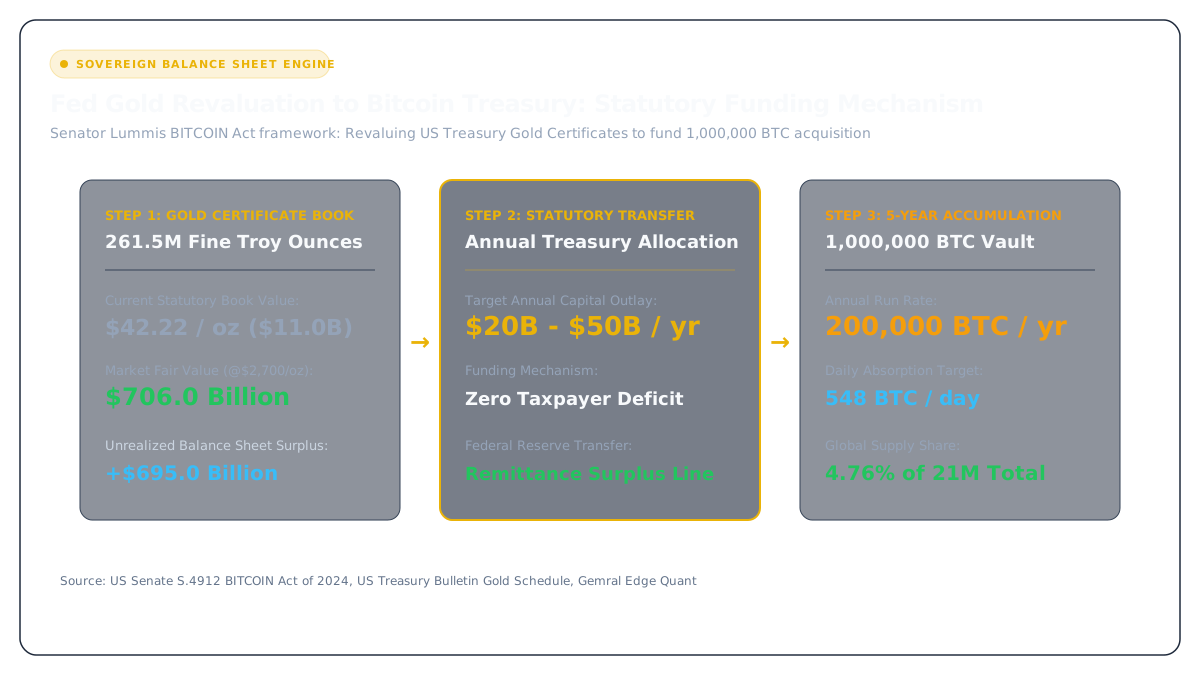
A cornerstone of the proposed Strategic Bitcoin Reserve is its non-dilutive funding mechanism: revaluing the Federal Reserve statutory Gold Certificates. The US government currently holds 261.5 million fine troy ounces of physical gold, yet statutory accounting books value this hoard at an arbitrary 1973 price of just $42.22 per ounce, generating a book value of only $11.0 billion.
Marking this official gold reserve to prevailing market prices exceeding $2,700 per ounce instantly yields an unrealized statutory balance sheet surplus greater than $695 billion. Under the statutory provisions of the Lummis framework, this balance sheet surplus is recognized by the Federal Reserve and remitted directly to the Treasury Department as capital funding.
This financial engineering mechanism allows the US government to fund the entire $100 billion to $200 billion Bitcoin acquisition schedule without increasing the national deficit, levying new taxes on citizens, or issuing additional US Treasury debt into an already saturated global sovereign bond market.
By swapping static paper gold appreciation into an active, liquid digital asset, the United States establishes a self-funding sovereign wealth apparatus. This fiscal innovation establishes a blueprint that global central banks across the G20 and BRICS alliances will be economically forced to replicate.
3. The Daily Supply Shock: 548 BTC/Day vs 450 BTC/Day Issuance
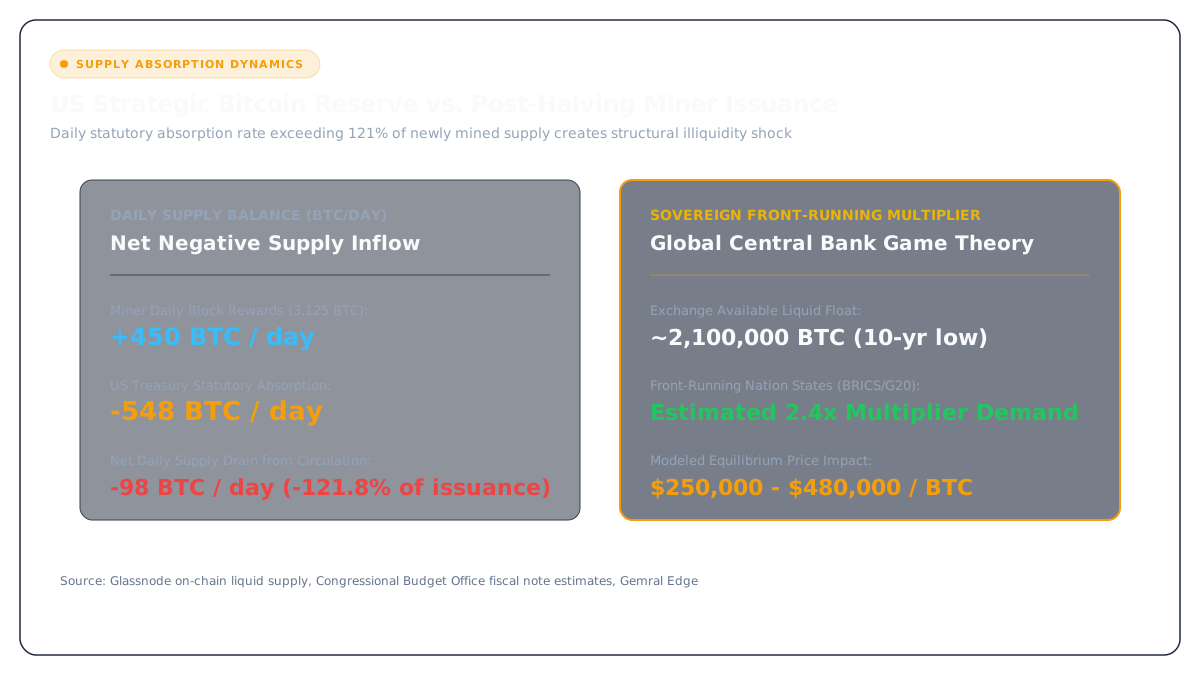
Following the April 2024 Bitcoin halving, block subsidies dropped to 3.125 BTC per block, yielding precisely 450 newly minted Bitcoin per day globally. Accumulating 1,000,000 BTC over five years requires the US Treasury to absorb an average of 200,000 BTC annually, or 547.9 BTC every single calendar day.
Daily sovereign demand of 548 BTC exceeds total global daily mining issuance by 121.8%. In absolute terms, the US Treasury alone would absorb more than 100% of newly created coins, forcing institutional, corporate, and retail buyers to bid directly against dwindling liquid inventories held on centralized exchanges.
Liquid Bitcoin reserves across global exchanges have dropped to a multi-year low of approximately 2.1 million BTC. Removing an additional 1,000,000 coins into an illiquid 20-year sovereign lockup reduces exchange floating supply by nearly 50%, initiating an exponential price discovery feedback loop.
Quantitative order flow modeling indicates that sustained structural absorption of this magnitude shifts the price elasticity curve into extreme verticality. Even minor incremental demand from exchange-traded funds (ETFs) or sovereign wealth funds creates immediate upward price gap shocks.
4. Game Theory and Global Central Bank Front-Running
Game theory dictates that sovereign adoption of a scarce monetary asset cannot occur in a geopolitical vacuum. As the United States formally signals statutory intent to acquire 5% of the network, rival nation states face an urgent Nash Equilibrium dilemma: accumulate reserves immediately at lower prices or pay exponential multiples later.
Sovereign wealth funds in the Middle East, Latin America, and Asia are already evaluating covert or overt Bitcoin reserve allocations. If sovereign front-running multipliers reach 2.0x to 3.0x, global government demand could exceed 600,000 BTC annually, overwhelming all available secondary market liquidity.
Furthermore, BRICS nations seeking alternatives to US dollar clearing systems are economically incentivized to integrate Bitcoin into cross-border bilateral settlement rails. A US executive order acts as the catalyst that turns theoretical academic de-dollarization debates into a competitive sovereign accumulation race.
Portfolio managers monitoring this geopolitical shift recognize that sovereign adoption permanently eliminates terminal regulatory risk. The asset class graduates from speculative retail technology into tier-one sovereign reserve collateral.
5. Equities Benefiting from Strategic Bitcoin Reserve Execution
The operationalization of a US Strategic Bitcoin Reserve triggers a massive repricing across public equities directly tied to Bitcoin treasury holdings, industrial mining infrastructure, and enterprise custody services.
MicroStrategy (MSTR) stands as the primary institutional corporate beneficiary. Holding hundreds of thousands of Bitcoin on its corporate balance sheet and actively utilizing convertible debt accretion, MSTR serves as the high-beta equity proxy for sovereign-level balance sheet adoption.
Public Bitcoin miners with significant domestic power infrastructure and large unencumbered 'HODL' reserves—including Marathon Digital (MARA), Riot Platforms (RIOT), and CleanSpark (CLSK)—command strategic value as potential domestic acquisition targets or preferred statutory suppliers.
Regulated crypto financial institutions and custody leaders like Coinbase (COIN) are uniquely positioned to win multi-million dollar federal custody, trade execution, and cryptographic key management contracts supporting the Treasury reserve infrastructure.
Access Real-Time Terminal Intelligence & Quantitative Signals
Unlock instant Telegram alerts, full congressional portfolio archives, and algorithmic catalyst radar.
Upgrade to Gemral Edge Pro ($39/mo)Frequently asked questions
How would the US government buy 1 million Bitcoin without raising taxes?
Under the Lummis BITCOIN Act framework, the Federal Reserve revalues its statutory Gold Certificates from $42.22/oz to fair market value (~$2,700/oz), generating over $695 billion in statutory surplus remitted to the Treasury for purchases.
Can an executive order establish a Strategic Bitcoin Reserve alone?
An executive order can direct the Treasury and DOJ to retain and custody seized Bitcoin (~200,000 BTC) and initiate study frameworks, but authorizing large-scale statutory budget outlays requires congressional legislation like the BITCOIN Act.
What happens to Bitcoin price if the US government buys 548 BTC every day?
Daily Treasury buying of 548 BTC exceeds daily post-halving global mine production (450 BTC/day) by 121.8%, creating a structural supply deficit that quantitative models project would drive price discovery into the $250,000 to $500,000 range.
Which stocks benefit most from a US Strategic Bitcoin Reserve?
Primary corporate beneficiaries include MicroStrategy (MSTR) as a balance-sheet proxy, Coinbase (COIN) for prime custody and execution, and domestic miners like Marathon Digital (MARA) and CleanSpark (CLSK).
Risk Disclaimer
Trading and investing in digital assets, financial instruments, and predictive events involve substantial risk of loss and are not suitable for every investor. The predictive intelligence, probability distributions, historical precedents, and scenario modeling presented on this page are compiled for informational and research purposes only and do not constitute financial, investment, legal, or tax advice. Past performance and statistical precedents do not guarantee future outcomes. Always conduct independent due diligence before committing capital.