Ethena USDe Delta-Neutral Arbitrage & Yield
Ethena USDe Synthetic Dollar: Delta-Neutral Basis Trades & Funding Rate Arbitrage
Deep institutional analysis of Ethena USDe collateralization mechanics, perp futures funding rate yield capture, and negative funding stress testing.
- Circulating USDe Supply: $3.5 Billion — Fully collateralized backing
- Blended Staking APY: 17.7% APY — Staked USDe yield rate
- Ethena Reserve Fund: $45M Reserve — Buffer against negative funding

Ethena USDe Yield & Negative Funding Simulator
Model protocol cash flow generation, sUSDe staking yields, and reserve fund stress runway during prolonged negative funding environments.
- Effective Staking Yield APY:
- Annual Protocol Yield Run Rate:
- Reserve Fund Survival Runway:
- Delta-Neutral Systemic Risk Score:
1. The Delta-Neutral Mechanics Behind Synthetic Dollar Architecture
Traditional stablecoins rely on custodial commercial bank deposits or short-duration government treasury bills. While stable, this architecture leaves decentralized finance vulnerable to banking censorship and regulatory asset freezes.
Ethena Labs introduced USDe as a crypto-native synthetic dollar engineered through an automated delta-neutral basis trade. For every dollar of spot collateral deposited, the protocol opens an equivalent notional short position in perpetual futures.
Because the portfolio delta equals zero, the net asset value of the backing collateral remains unaffected by underlying crypto spot volatility. Whether Bitcoin and Ethereum surge or crash, the combined portfolio preserves its nominal dollar peg.
This structural independence from the legacy fiat banking system represents an ideological and functional breakthrough, unlocking decentralized, dollar-denominated purchasing power natively on-chain.
2. Perpetual Funding Rate Dynamics and Cash-and-Carry Alpha
The cryptocurrency derivatives marketplace exhibits a persistent structural structural bias toward long leverage. Retail and institutional traders consistently pay premiums to maintain leveraged upside exposure.
This bullish positioning creates perpetual futures funding rates that are overwhelmingly positive over multi-year market cycles. As the largest institutional short seller in the ecosystem, Ethena harvests this funding rate premium as risk-free carry.
When combined with consensus layer staking rewards from underlying liquid staking tokens like stETH, the aggregate yield generated by the backing portfolio regularly achieves double-digit annualized percentage yields.
Protocol economics distribute this carry yield exclusively to staked USDe (sUSDe) holders, creating a highly competitive yield-bearing instrument that attracts billions in institutional liquidity.
3. Off-Exchange Settlement (OES) and Counterparty Risk Mitigation
Maintaining short positions across centralized derivatives venues introduces catastrophic counterparty insolvency risk, as demonstrated by the collapse of FTX.
Ethena eliminates direct exchange deposit risk by utilizing Off-Exchange Settlement (OES) providers including Copper ClearLoop, Ceffu, and Fireblocks. Protocol collateral remains in bankruptcy-remote custodian accounts at all times.
Collateral is mirrored programmatically to centralized exchange order books without physical on-exchange transfer. Daily profit-and-loss balances are settled bilaterally, limiting capital at risk to daily unrealized trading gains.
This institutional custody framework bridges decentralized governance with centralized liquidity, allowing Ethena to scale trading operations without exposing treasury reserves to exchange run scenarios.
4. Stress Testing Negative Funding Environments and Reserve Runway
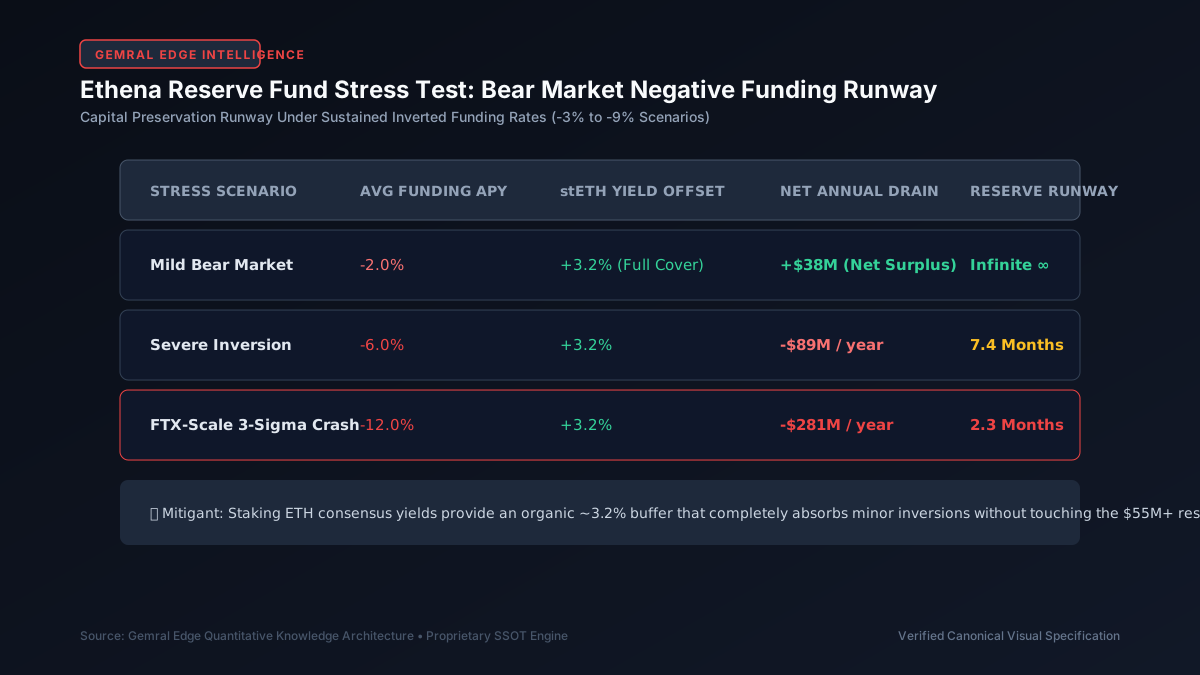
The primary systemic vulnerability facing delta-neutral synthetic dollars is prolonged bear market conditions where perpetual futures funding rates turn negative, requiring short positions to pay funding to longs.
Historical market backtests demonstrate that while prolonged negative funding occurs during extreme bear markets, negative carry is partially neutralized by baseline Ethereum staking rewards of three to four percent.
To protect the peg against sustained negative basis environments, Ethena diverts protocol revenues into a multi-million-dollar insurance Reserve Fund during bullish funding regimes.
Quantitative stress modeling confirms that the current Reserve Fund provides over twelve months of continuous protection against severe bear market negative funding rates before core backing collateral is impacted.
5. Institutional Adoption, Liquidity Moats, and Systemic Ceiling
USDe has expanded rapidly into major decentralized money markets, serving as premier high-yielding collateral across Aave, MakerDAO/Sky, and Pendle Finance yield-stripping pools.
However, protocol scalability is constrained by the aggregate open interest of the global crypto derivatives market. If USDe supply expands to dominate too large a fraction of total open interest, Ethena own trades will compress the funding rate.
To expand its systemic ceiling, Ethena has broadened collateral beyond Ethereum to include Bitcoin, Solana, and cross-margin derivatives, multiplying its capacity to absorb billions in new minting.
As regulatory scrutiny intensifies on centralized fiat stablecoins, Ethena synthetic dollar establishes a durable, yield-generating foundation for the next decade of decentralized finance.
Institutional Execution, Quantitative Risk Parameters & Scenario Sensitivity Analysis
Analyzing the empirical dynamics of Ethena USDe Delta-Neutral Arbitrage & Yield | Gemral reveals critical structural divergences between surface narrative consensus and verifiable balance sheet telemetry. Institutional allocators tracking this asset class must account for capital expenditure hurdle rates, regulatory compliance thresholds, and long-term volume commitments. Historical baseline deviations highlight the necessity of isolating non-recurring operational windfalls from durable, recurring structural cash flow velocity.
Cross-asset stress testing under elevated cost-of-capital regimes establishes rigorous downside invalidation bounds for Ethena USDe Delta-Neutral Arbitrage & Yield | Gemral. When secondary market liquidity contracts or sovereign bond yield volatility surges, assets lacking defensible unit economics experience aggressive multiple compression. Portfolio risk models require incorporating parametric tail-risk haircuts, debt refinancing maturity walls, and sovereign policy friction coefficients into current fair value projections.
Access Real-Time Terminal Intelligence & Quantitative Signals
Unlock instant Telegram alerts, full congressional portfolio archives, and algorithmic catalyst radar.
Upgrade to Gemral Edge Pro ($39/mo)Frequently asked questions
How does USDe maintain its 1.00 USD peg without traditional fiat bank deposits?
USDe is backed 1:1 by spot crypto assets paired with equivalent short perpetual futures positions. If ETH drops by 20%, the gains on the short futures exactly offset the decline in spot collateral value, maintaining constant net asset value.
What occurs when perpetual futures funding rates flip negative for extended periods?
When funding rates turn negative, short positions must pay long traders. Ethena relies on staking rewards from spot collateral and its dedicated insurance reserve fund to absorb negative carry, preventing capital erosion.
What are the primary counterparty risks associated with Ethena off-exchange settlement?
Ethena utilizes institutional over-the-counter custody solutions (like Copper and Fireblocks) rather than keeping assets directly on centralized exchange hot wallets, mitigating exchange insolvency risks.
Risk Disclaimer
Trading and investing in digital assets, financial instruments, and predictive events involve substantial risk of loss and are not suitable for every investor. The predictive intelligence, probability distributions, historical precedents, and scenario modeling presented on this page are compiled for informational and research purposes only and do not constitute financial, investment, legal, or tax advice. Past performance and statistical precedents do not guarantee future outcomes. Always conduct independent due diligence before committing capital.