Lobbying Momentum: The Sectors Accelerating Federal Influence Capital in 2026
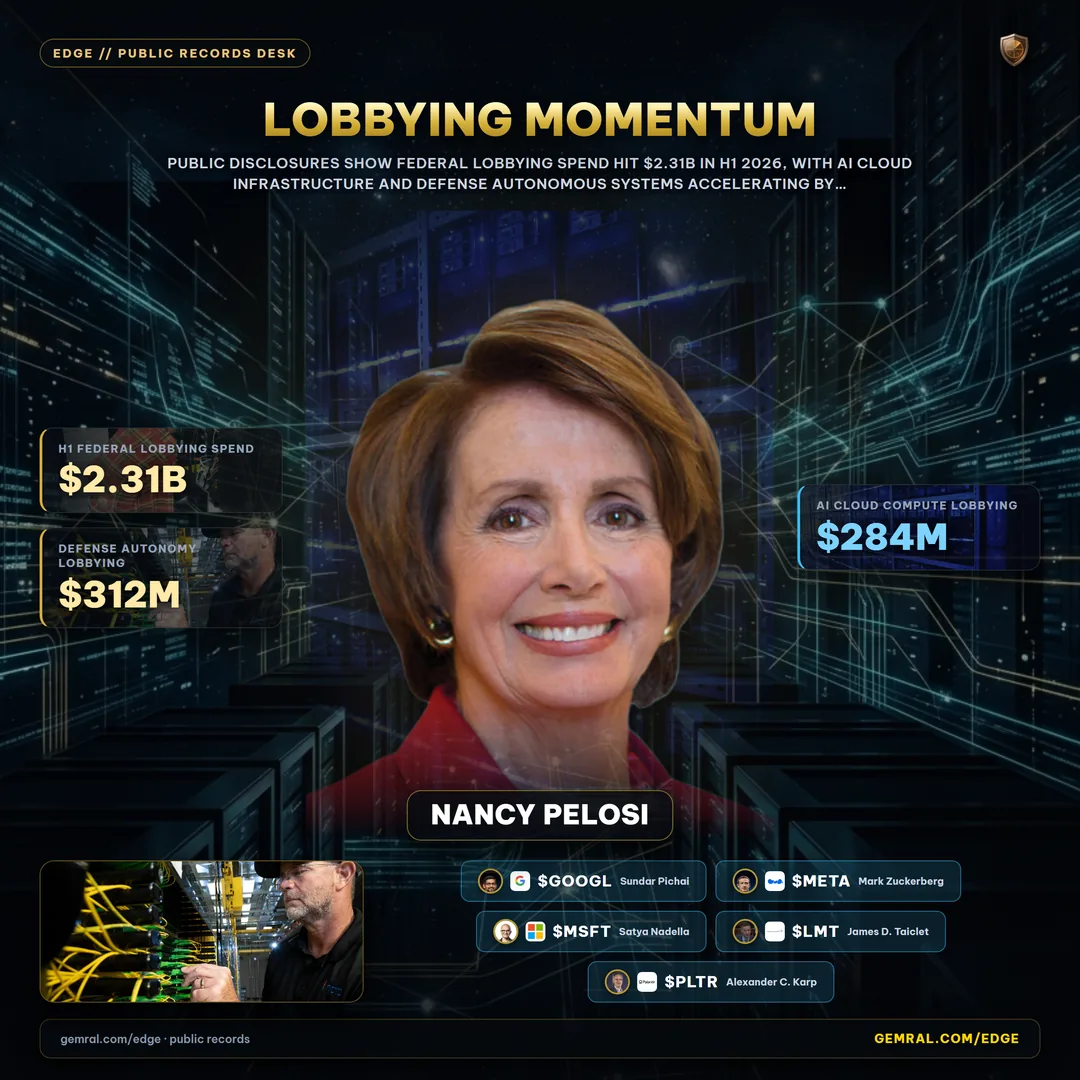
Across official quarterly disclosure filings registered under the Lobbying Disclosure Act (tracked via the federal lobbying spend tracker), aggregate corporate expenditure on federal legislative advocacy reached $2.31 billion during the first six months of 2026 across 14,800 active filings. While overall influence expenditure expanded by 4.8% year-over-year, specific technological and industrial domains recorded unprecedented capital acceleration: Artificial Intelligence cloud compute lobbying rose 38.5% to $284 million, while Defense autonomous systems outlays advanced 24.1% to $312 million.
Sector Acceleration: Where Influence Capital Concentrated in H1 2026
Federal lobbying disclosures provide an empirical accounting of where regulated industries direct legislative advocacy resources before statutory language reaches committee markups. In historical baseline periods, lobbying allocations grow in close alignment with general corporate revenue expansion. However, the first half of 2026 documented an acute divergence across five primary industrial categories.
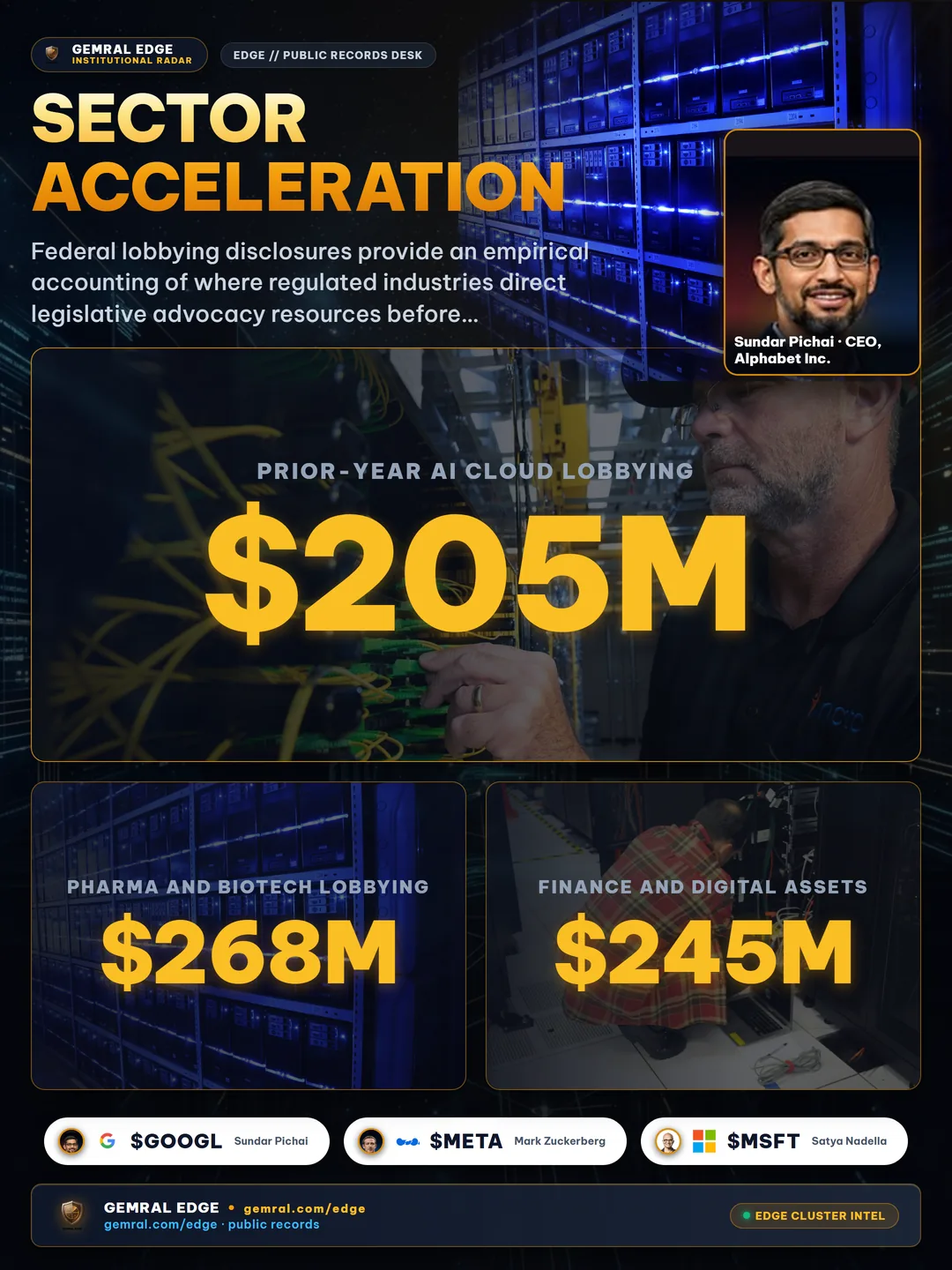
Defense and autonomous hardware contractors led all sectors in gross outlays, directing $312 million into congressional and agency advocacy—a 24.1% acceleration relative to the $251 million recorded in H1 2025. Technology firms focused on enterprise AI and hyperscale cloud infrastructure deployed $284 million, representing a 38.5% expansion from $205 million during the corresponding prior-year timeframe.
Pharmaceutical and biotechnology registrants maintained an elevated baseline of $268 million, but exhibited a modest 6.2% annual growth rate. Financial services and digital asset registrants deployed $245 million, reflecting an 11.8% expansion. Concurrently, energy grid equipment and critical domestic minerals producers spent $195 million, advancing 31.4% year-over-year.
| Industrial Sector | H1 2026 Lobbying Spend | H1 2025 Lobbying Spend | Year-over-Year Delta | Registered Lobbying Entities |
|---|---|---|---|---|
| Defense & Autonomous Systems | $312M | $251M | +24.1% | 1,420 |
| Tech & Cloud Infrastructure (AI) | $284M | $205M | +38.5% | 1,180 |
| Pharmaceuticals & Biotechnology | $268M | $252M | +6.2% | 2,150 |
| Financial Services & Fintech | $245M | $219M | +11.8% | 1,890 |
| Energy Grid & Critical Minerals | $195M | $148M | +31.4% | 840 |
The Multi-Year Trajectory: Evaluating 10 Quarters of Influence Activity
Evaluating quarterly expenditure over the ten quarters spanning Q1 2024 through Q2 2026 highlights a persistent upward structural shift. During 2024, quarterly federal lobbying totals hovered near $1.02 billion to $1.08 billion: Q1 2024 registered $1.02 billion, Q2 2024 recorded $1.05 billion, Q3 2024 marked $1.01 billion, and Q4 2024 totaled $1.08 billion.
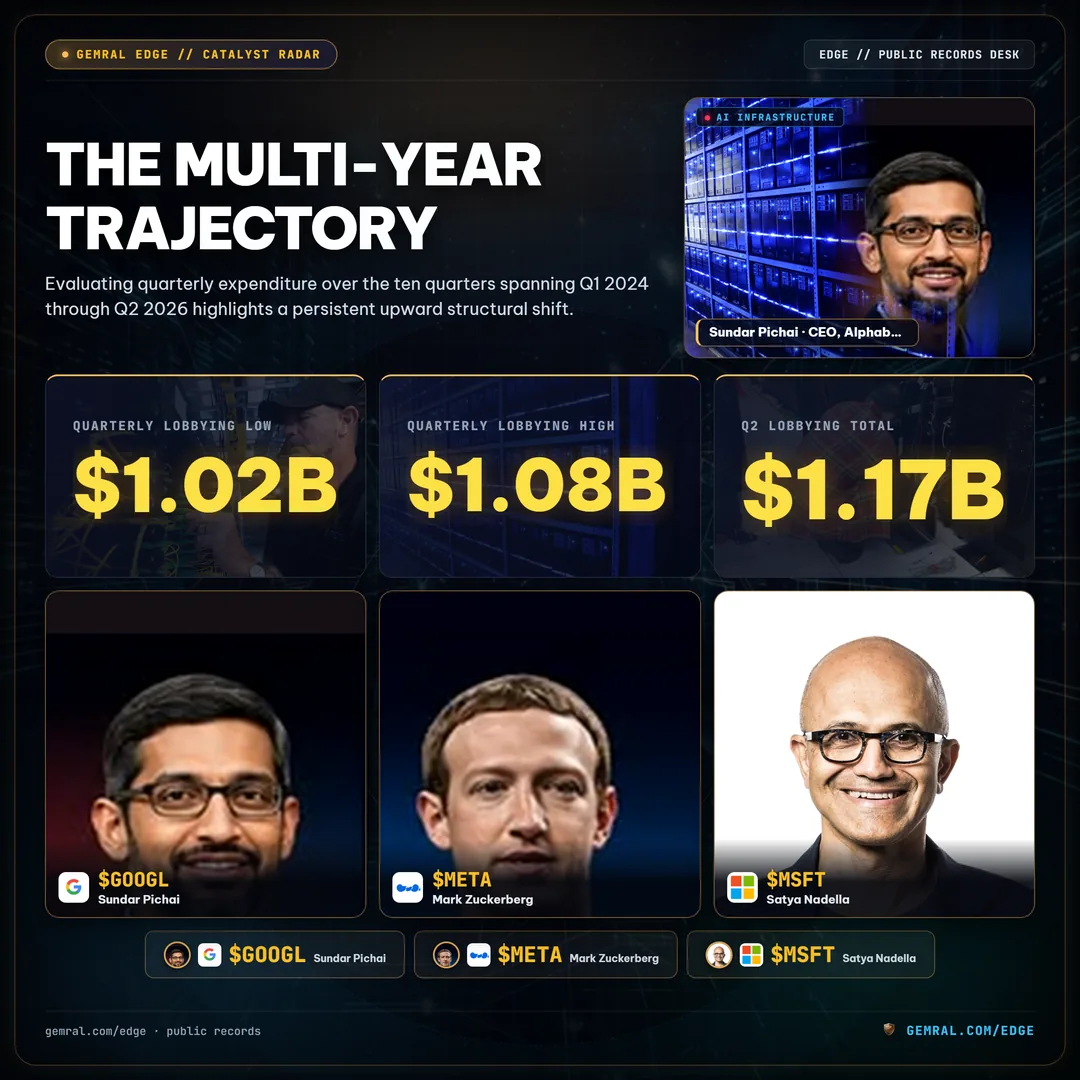
In 2025, aggregate spending climbed steadily: Q1 2025 stood at $1.09 billion, Q2 2025 reached $1.12 billion, Q3 2025 measured $1.11 billion, and Q4 2025 totaled $1.16 billion. This ascent accelerated during 2026, with Q1 2026 posting $1.14 billion and Q2 2026 recording $1.17 billion. Together, these totals established the two-quarter record of $2.31 billion.
This persistent climb demonstrates that federal influence commitments have not receded following major election cycles; rather, strategic allocations have intensified as federal industrial policy and defense modernization frameworks entered active implementation phases.
Top Corporate Filers: Capital Concentration in Tech and Defense
Dissecting individual entity disclosures filed with the Secretary of the Senate indicates high capital concentration among strategic defense contractors and enterprise technology platforms. In the technology cohort, Alphabet deployed $14.8 million during H1 2026, prioritizing federal artificial intelligence procurement standards and data privacy mandates. Meta Platforms reported $12.6 million, while Microsoft registered $9.8 million across cloud computing and cybersecurity policy dockets.
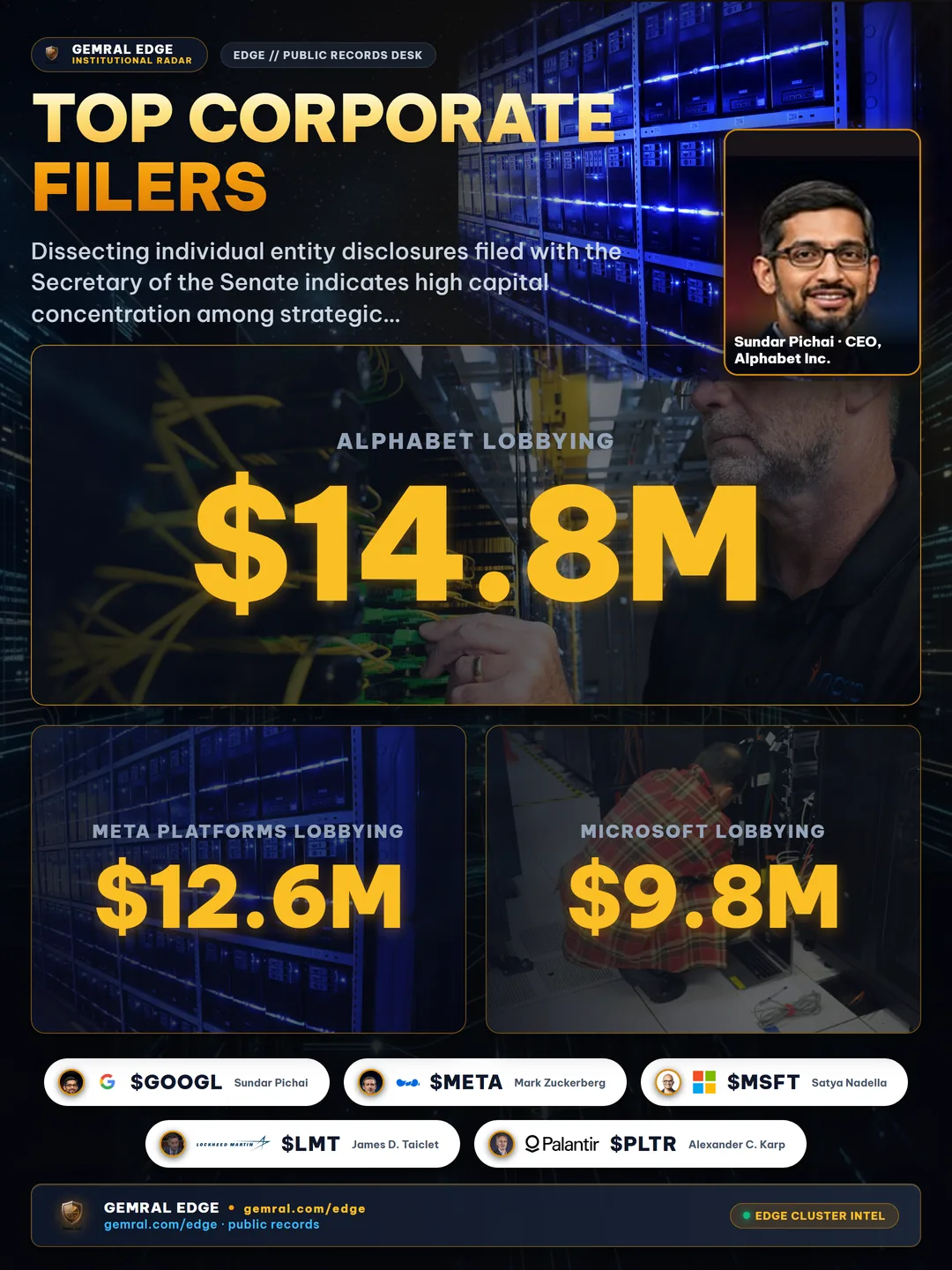
Within defense aerospace and software, Lockheed Martin reported $8.4 million in direct lobbying expenditures, followed by RTX Corporation at $7.6 million, directed toward next-generation interceptor and tactical radar authorizations. Concurrently, enterprise analytics and operational defense software provider Palantir Technologies filed $4.2 million, an increase from $2.8 million in the prior-year period, focusing explicitly on automated data integration across military theater commands.
Examining these specific corporate filings confirms that legislative advocacy is closely aligned with high-value procurement initiatives rather than generalized brand positioning.
The Transmission Sequence: From LDA Filing to Federal Contract Obligation
Quantitative tracking of federal policy records indicates that lobbying expenditures function as an early signal within a 210-day median transmission sequence. Corporate capital deployed in legislative advocacy typically precedes formal committee hearings, legislative authorization language, and agency procurement obligations.
- Phase 1 (T0): Lobbying Surge — Initial acceleration in LDA quarterly disclosures, registering specific bills and program appropriations.
- Phase 2 (T+45d): Committee Deliberation — Congressional committees schedule public hearings, witness testimony, and staff-level draft revisions.
- Phase 3 (T+120d): Statutory Authorization — Insertion of specific procurement language into authorization and annual appropriations legislation.
- Phase 4 (T+210d): Agency Contract Obligation — Executive agencies obligate capital and issue formal contract awards to verified corporate contractors.
Because LDA disclosures are filed under strict quarterly statutory timetables, public records make these spending shifts visible up to seven months before corresponding contract actions appear in agency ledger records. Tracking this initial phase provides clear telemetry on where regulatory and budgetary momentum is building.
Deep Flow and Multi-Signal Convergence
When evaluated independently, an increase in lobbying expenditure simply indicates an organization's willingness to commit resources to legislative dialogue. However, within the Gemral Edge intelligence framework, lobbying momentum is cross-referenced against independent operational datasets to identify structured convergence.
Through Deep Flow monitoring, institutional capital positioning and off-exchange accumulation patterns are evaluated alongside federal lobbying filings. When accelerated lobbying outlays by strategic defense or technology contractors converge with cluster purchases disclosed by congressional committee members under the STOCK Act, the information moves beyond isolated advocacy into a cross-layer alignment pattern.
In addition, Quasar Point convergence tracking measures the intersection of regulatory lobbying, federal grant appropriations, and supply chain commitments against broader macro liquidity backdrops. In an environment where the Federal Reserve maintains a net liquidity base of $5.77 trillion, legislative capital flows delineate which specific industrial sectors are capturing structural federal priorities.
Public Records and Policy Transparency
All data analyzed in this report is sourced directly from public disclosure records maintained by the federal government under the Lobbying Disclosure Act of 1995 and the Honest Leadership and Open Government Act of 2007. Analyzing these records systematically transforms fragmented individual filings into an empirical map of legislative focus.
Capitol Intelligence: Lawmaker asset allocations disclosed under federal ethics rules—most visibly tracked in the Nancy Pelosi STOCK Act disclosures—illustrate how congressional committee jurisdictions intersect with private sector lobbying momentum.